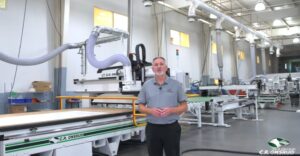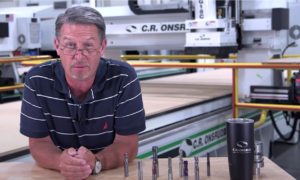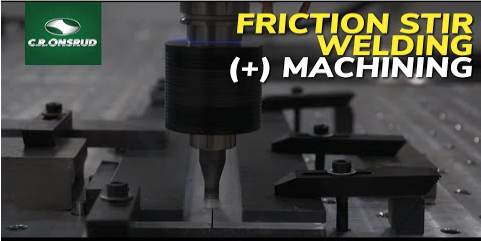
Reduce material handling and setups for more efficient production and eliminate the need for two machines.
What is Friction Stir Welding?
With the use of minimal heat (caused by friction) and high pressure, the friction stir welding technique blends (stirs) softened particles together at the seam to fuse (weld) different parts into one molecularly cohesive piece. This unique welding process can produce defect-free bonds without the use of flux, fillers, or a shielding agent. Friction stir welding is typically a standalone process, requiring a specialized CNC machine. Most manufacturer’s use another machine when it comes to removing burrs or “slag” or when milling the part for additional form, fit, or function. C.R. Onsrud, however, performs friction stir welding and CNC milling operations on a single machine for a 2-in-1 solution.
Why/when is Friction Stir Welding used?
The solid state joining process that friction stir welding provides is ideal when you need a seamlessly strong bond without the added weight caused by bolts or rivets, for example. This method also solves for materials that otherwise would be difficult to weld: aluminum alloys, copper, magnesium, titanium, steel, stainless steel, nickel, lead, zinc, and thermoplastics.
Friction stir welding is an eco-friendly welding process that provides health safety benefits by bonding materials without producing fumes, smoke, radiation, or arc glare. It also does not use flux, fillers, or a shielding agent.
While other methods of welding are slow, friction stir welding brings with it the advantage of a clean, safe, automated process for consistent, repeatable results. You produce butt welds, T-joints, L-joints, and circumferential configurations all in a single pass. Not only does it deliver higher joint strength than many other methods, but the fused area in most cases is stronger than the individual base materials.
What are the Advantages of this 2-in-1 Machining Solution?
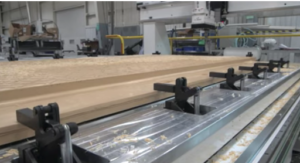
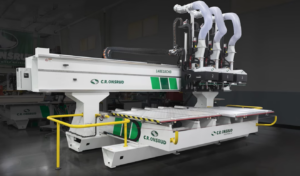
Combining welding and milling on the same machine reduces material handling, changeover time, and fixturing. Traditionally, friction stir welding requires an additional process to complete a part. From simply removing a leftover burr to tapping threaded holes, milling slots, or sawing off end pieces, these processes are usually completed on another machine. This second machine costs money, takes up floor space, requires a second program, and often another employee to run it. This is where C.R. Onsrud’s 2-in-1 machine solution truly takes your manufacturing to a new level. You can friction stir weld and perform drilling, milling, tapping, and/or sawing without ever moving that part once. When you’re not friction stir welding, your machine operates like a normal mill.
This 2-in-1 solution is available on a variety of 3- and 5-axis C.R. Onsrud machines, ranging in work envelopes from 4′x8′ to 20′x100′. Let C.R. Onsrud outfit your shop floor with a 2-in-1 machining center, and watch how quickly you’re seeing a positive return on your investment.
Some Examples Where Friction Stir Welding Is Used
Electronics – heat exchangers, enclosures
Automotive – trailer blanks, body panels, trailer decks
Electric Vehicle – battery trays, skateboard assy, drive & brake cooling system
Defense – armored vehicle, satellite housing
Aerospace – propellant tanks, capsule assy
Aviation – spun-formed lip skins, fuselage
Marine – bulkhead and deck assy
Energy – canisters, piping systems
Railcar – single and dual wall body panels
R&D institutions