CNC Machines on Better Track Than Robots on Rails
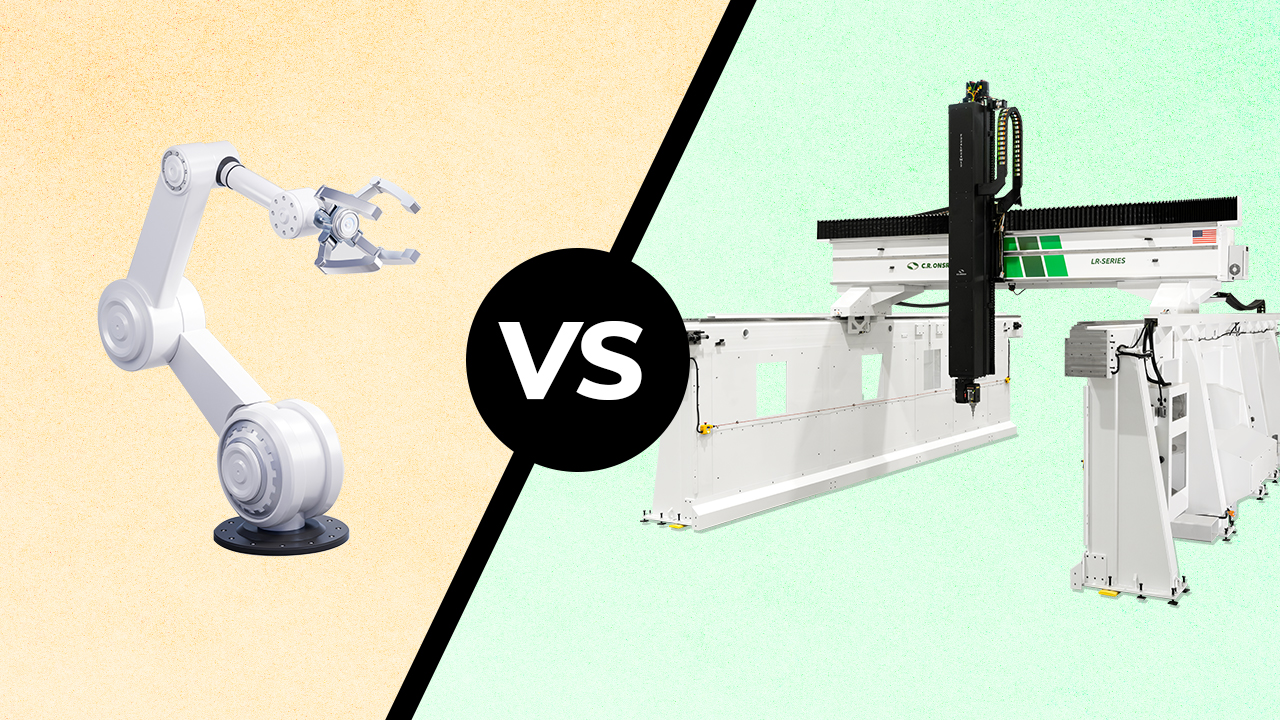
Although the CNC landscape has evolved, the historical practice of using robots on rails has continued, especially for manufacturing large parts; e.g., mass timber CLT, SIP, LVL, etc. panels, automotive chassis and frames, aerospace fuselage panels, and much more. This tradition is in part due to misinformation that has been circulating for years when it comes to the CNC machine versus a robot on a rail.
Myth #1: Once programmed for a specific application (e.g., milling), you need to buy a different CNC machine for other applications (e.g., drilling).
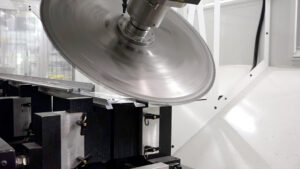
Fact: Like robots, a CNC (computer numerical controlled) machine is a tool that does whatever it is programmed to do. Depending on the CNC machine, not only does one machine have the flexibility to drill, mill, turn, tap, and saw, but it can also perform these functions on a broad range of materials (e.g., wood, plastic, aluminum, melamine, mass timber (such as CLT, SIP, etc.). In fact, there are machines that have the versatility to not only mill but also friction stir weld and flow drill — and impressively can perform all these operations on one machine in a single setup!

Myth #2: CNC machines cannot access difficult angles, thus limiting the complexity of cuts.
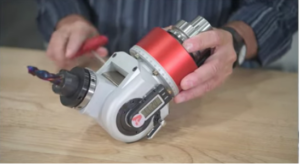
Fact: 3-axis routers were the foundation of modern machining and did only operate in the XYZ linear plane. However, with the development of aggregates (giving 3-axis machines the range of a 4th axis) and the even more advanced 5-axis CNC machines, multi-face machining is prevalent. Following intricate tool paths (in the XYZ linear plane and with two additional rotational axes), 5-axis CNC machines create highly detailed 3D components across a broad range of materials.

Myth #3: The capacity and range of motion of CNC machines is limited, so they cannot handle large or extremely heavy materials.
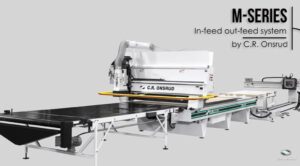
Fact: There are machines with enormous work envelopes. The C.R. Onsrud HR-Series, for example, has a work area as large as 21′x100′+ and a whopping 10′ of Z-stroke. This capacity — easily competing with the range of a robot arm — makes it ideal for processing wood frames, aluminum billet, composite molds, and incredibly large mass timber panels. Not only can this machine handle large lengths, widths, and heights, it can support the weight of extremely heavy materials and is only limited by the capacity of the manufacturer’s floor on which the material is held.

Myth #4: Programs for robots are cheaper and more flexible.
Fact: Since most robot manufacturers use proprietary software, costs are brand dependent. CNC machines have a standard programming language (G-code/M-code) used by CAD/CAM software packages which vary in price. Later in this article, the topic of program complexity is factored into the equation.
Consider also what kind of support you’re getting with your purchase. For example, C.R. Onsrud includes operator training in the price of the CNC machine and have found that most of their customers are in production before the on-site training is even complete. With robots, typically customers receive only basic training, not how to actually program a robot.
As far as versatility, a CNC machine does whatever it is programmed to do. With the right CNC machine, a shop could be making melamine cabinets in the morning and foam decking for a boat in the afternoon. Or even performing these applications simultaneously using dual process technology.*
* Dual Process: By adding a second spindle, one spindle can perform operations on one table or zone, while the second spindle performs completely separate operations on another table or zone, essentially turning one machine into two (or more, with each additional spindle).

Recognized Facts:
Fact: Due to their lack of rigidity, robots on rails are less accurate than CNC machines.
CNC machines offer what robots on rails notoriously lack, namely, high accuracy. Although not all CNC machines are built the same, the fully reinforced ones have the structural integrity and rigidity required to provide precision along with top acceleration and deceleration speeds, long tool life, and low maintenance over the lifetime of the machine. The more rigid the machine, the better the cut quality, which equates to a higher quality end product.

Fact: Programming robots is complex.
There is no single universal adopted language for robots. To program the robot to move, utilize its range of axes, and operate in its physical space is a significant time investment, which is multiplied by each different brand of robot.
By comparison, CNC machines have a standard programming language (G-code/M-code), so once a programmer or operator learns these codes, manual adjustments can be made quickly at the controller. Plus, they can reach out to a vast community of programmers to answer any coding questions.
Although CNC machines do require computer software programs to run, they don’t necessarily require you to have a programmer on hand. Prepackaged software can have the machine up and running as soon as it’s installed.
In addition to programming time, consider setup time as well. Depending on the complexity of the shop’s layout, it could take weeks or even up to a month to have robots ready for production.
For CNC machines, it depends on the manufacturer and if it’s shipped from overseas in several containers. C.R. Onsrud’s large-format HR-Series CNC machine has multiple assemblies that take about two full weeks to set up, but a majority of their machines ship as one fully assembled piece and, after adjusting the leveling bolts and hooking up the service connections (e.g., electrical, pneumatic), the machine is ready for production that same day.

Fact: Robots cannot readily pivot to new tasks.
As previously mentioned, programming robots is complex, so if you want them to perform something new, it’s an involved process.
With advanced CNC tools, it is easy to direct a CNC machine to readily perform a new task. For example, Onsrud’s SeeNC Interface™ provides an interactive graphical view of the spindle, clamps, vacuum zones, fixtures, tool paths, etc. If a plywood panel has an imperfection, such as a void, the operator can easily rearrange parts on the screen, without ever touching the code, and the machine will automatically avoid that area. The operator can also graphically shift parts around, for example, to create a nest (a tight arrangement of parts for maximum material yield), and then save the new cutting path for future use, essentially retraining the CNC machine on the fly with a new repeatable program.
Osync Machine Analytics® is another tool that helps operators easily pivot the production. Osync keeps operators informed of the machine’s status and performance in real time, so they can see issues immediately and readily adjust their CNC machining accordingly.

Fact: It can be a great benefit to manufacturers when robots are integrated into a CNC machining process.
Strategically incorporating robotic devices into a production line makes processes faster, more efficient, and safer. Solutions should be balanced for optimized efficiency and maximized profits. Speeding up some operations only to create bottlenecks downstream doesn’t help your production line or your bottom line.
Robots can be programmed to handle the more tedious tasks and backbreaking work, such as picking parts, removing scrap, managing hundreds of high-mix materials across a warehouse, ordering rainbow stacks to match the order of the program being run, etc.
When it comes to performing high-speed milling, drilling, sawing, tapping, and other machining operations, that work is best left to the CNC machine.

Additional resources:
Large-format CNC machinery: HR-Series, LR-Series, 3-Axis G-Series, and 5-Axis G-Series.
YouTube: Overcome Machine Challenges When Your … Components are XXL.
YouTube: Massive Tools for Mass Timber.
See also: CNC machinery for your application.