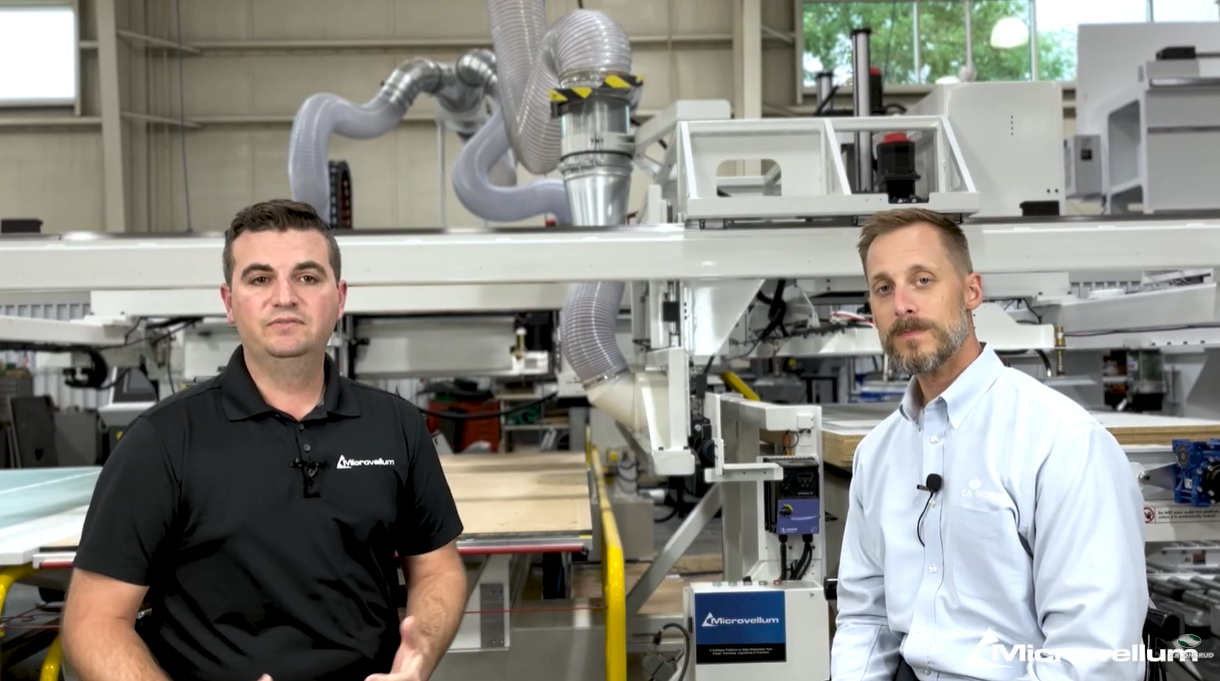
Garin Trimble, of Microvellum, sits down with Thomas Tuck, of C.R. Onsrud, to discuss what to consider before making an investment in machine technology. Learn the questions you should be asking of your company and of the machine manufacturer to ensure you make the most informed decision and the right machine for your company.
This is the transcript of the interview. The video is available on our YouTube channel.
Garin Trimble:
The time we live in today, investing in machine technology can be an overwhelming and daunting process. No one wants to make the wrong investment and then be stuck with a solution that doesn’t meet the needs of the company. But where should a company start when beginning to research machine technology? What should they be looking for in a CNC machine? And what questions should they be asking?
We, at Microvellum, along with our industry partner C.R. Onsrud are very happy to answer those questions for you. We’re here at this beautiful facility of C.R. Onsrud, here in Troutman, North Carolina. We’re speaking to Thomas Tuck, regional account manager for C.R. Onsrud. Thomas, I know you’ve been in the industry a very long time, but could you please tell us a little bit about yourself?
Thomas Tuck:
Yeah, absolutely. [I] Start[ed] off doing woodworking in High School … cabinet-making classes, and you’re learning about various types of wood and whatnot. And [I] transition[ed] that into a degree at Appalachian State University and furniture design and manufacturing and just kind of found it in my blood, so to speak, and love the industry. So, [I] somehow wiggled my way into the machinery side of it. It’s a lot of fun getting to work with you, companies looking to achieve certain goals or solve certain problems … help them with their struggles from a manufacturing level and incorporating technology and having some fun along the way.
Garin Trimble:
As we walked around this facility, we’ve seen all types of different machines, all types of equipment [and] different options within those machines. Could you tell us what are some questions that typically you ask customers that reach out to you contemplating or considering adding a CNC to their process?
Thomas Tuck:
So we really try to partner up with companies and get to know them first — really dig deep into what they believe they need. Let’s talk about what their vision is. What they’re currently doing and how that growth may impact their business over time. It’s kind of like a doctor’s visit. You have a problem. There could be different solutions. So, we’ve got to have a couple of discussions to figure out which path is best for that individual, because there’s no one way to do it. There’s a couple different ways, a couple different levels of technology, and that fit could be very different for two companies that are essentially doing the same thing.
Garin Trimble:
Now as I understand it there are multiple levels of different CNC equipment. Could you explain what those levels are, and then maybe even more importantly, how would a customer understand where they fit into that process.
Thomas Tuck:
A CNC router investment at any level is essentially that. It’s an investment. You want a return on that investment at the end of the day. So, you have a hobby type routers, small tables very basic — you’re making widgets for flea markets on the weekends. It could be an ideal solution. You have your kind of middle range, which we call the commercial level CNC router, which can be [where] you’re getting into more profitability, but maybe not at the scale where you need a heavy-duty solution with automation or multiple spindles or running all day every day. And then you get kind of in the industrial level, which is that upper tier. You’re an established company. You’re looking to reduce your labor, increase profitability, increase output — really take your company to the next level. So you need an industrial level CNC router to do that.
Garin Trimble:
So our Microvellum customers have a wide range of different shops. They are customers themselves. [They have a] business that they’re operating and how they’re functioning. When do I know if I’m ready for an investment in automation?
Thomas Tuck:
The first part of what you said is kind of related to a big piece of the puzzle which is software. So, if a company has some type of CAD/CAM or some type of design software, that can be one of those boxes to check off — that, hey you’re ready for maybe your first CNC, or your second [CNC], or you’re improving the automation on that.
It really comes down to I think a few factors, right? Productivity. How much can I produce in a shift in a day, in a week? Whatever their customers [are] demanding of them in terms of lead time, output, things of that nature. I think another big factor to determine, let’s say for example, you have a CNC router now and maybe you’re ready for that next level [of] automation. If you’re a growing company, you need more people to handle more processes. Well automation can certainly eliminate or reduce the amount of heads that you have to have as you grow. So, incorporating more productivity, how can I control my labor? Or maybe you’re just struggling finding good labor. Automation can certainly help with those things.
Garin Trimble:
Yeah. We’ve certainly seen that throughout the pandemic too, for sure.
So, Thomas, what questions do you start with when a customer reaches out to you to really determine the best fit?
Thomas Tuck:
There’s a lot of questions, I mean as you try to help with customers as, let’s say, a trusted advisor, someone, a consultant, you definitely got to get to know them and build that trust with them and throughout that process. We try to identify a few key factors that really help tell us what size, what level of automation, what type of technology, or maybe even software that maybe they need to be successful.
So, what types of materials? Is it just sheet goods? What sizes? What thicknesses? Do we envision incorporating, let’s say solid wood and millwork, things of that nature? Where we are at today, and where do we want to be in a few years.
So, versatility is something we see a lot of people wanting — not just be kind of streamlined in one direction of their business, but they want to cater to a couple different markets. So, how does that versatility of the business impact how we would build or tailor a machine for somebody? What are we starting with? Those are things that are very important.
Labor force — the machine can definitely be something that is easily taught, but we have to have good programmers. You know, we have to have a CAD/CAM Department of some sort. So, do we have the personnel to kind of start that process?
And maybe even something as simple as what are our limitations? Can we fit a certain size machine in the building? Do we have ample amount of power? Do we have good dust collection? What are the limitations that may help drive us into what the best fit is. Or there’s limitations that maybe drive what we just can do because of those limitations.
Garin Trimble:
So, as someone’s evaluating whether or not to add CNC manufacturing or automation into their process, how should they determine should it be a nested-based CNC or a point-to-point and maybe beam saw, [or] a combination or more of a cell-based manufacturing?
Thomas Tuck:
There’s a lot of different ways to accomplish the end goal, right? But I think along that process, the versatility is very, very important because point-to-points, pod and rail machines, and panel saw, what you may refer to as cut band of operation, is really dedicated more for high volume of cabinetry. What we may be limited on is the versatility to do other materials or other types of millwork, or things that your customers may ask you in the cabinet industry. Let’s say, so how important is that versatility today, tomorrow, five years from now?
Production — am I doing 40 sheets a day? Am I doing a hundred? Two hundred? Where am I at today? Where do I want to be? A lot of times, you can create a ceiling with an investment, and you can outgrow that solution very easily. So, incorporating that future growth that you grow into the CNC or whatever the solution may be is very, very important. So, if that high volume panel processing is something they visualize really growing tremendously over the next three, four, five years, then yeah, maybe a point-to-point panel saw is the right operation. But if they’re just not sure, maybe, let’s say, yield is very, very important to them, [then] maybe a nested-based router is the right fit. So weighing both options, I think, is a great question for anybody to ask us, you know, why should I do this or why not?
Garin Trimble:
Yeah. Excellent! I totally agree as well.
Yeah. So when is the right time to add a CNC?
Thomas Tuck:
It’s really tough to say. It’s funny you ask this question. I was talking to a company a couple months ago, and they asked a very similar question. The best way I could explain it, and I know this is going to sound kind of corny, but when my wife and I decided we wanted to have kids, we were trying to figure out when’s the right time. And there really isn’t an answer to that, right? You maybe have to have a few core things in place. You got to have a facility right? You’ve got to have some knowledge of what type of construction method or materials you may want to use. You’ve got to have maybe the ability to want to learn how to program something. So, there maybe isn’t a right time. But if you’re passionate about changing your business, about improving the output, improving the product that you’re selling to your customers, and really taking your company to that next level, [then] it’s probably the right time. But I wouldn’t say there’s always a January first of every year that is the right time, or whatever certain sales amount, because that CNC could help take your business to that next level. You may not want to wait till your business is at that level. And [then it’s] maybe too late.
Garin Trimble:
So are you saying we can program our kids?
Thomas Tuck:
Potentially if you have the right CAD/CAM Team.
Garin Trimble:
All right. How important is software?
Thomas Tuck:
Well, the machine is dumb, essentially. You have to tell it what to do, right? And that’s where design software and, more specifically, CAD/CAM comes into play. It’s not just gonna run itself. Yeah, so, in some cases I’ll even recommend to companies looking at investing in CNC that let’s separate these conversations, right? And maybe even start with the software, so that you can design, maybe implement some cost or estimating in your cabinetry. Learn, kind of, some of the core Basics. Get 50% or 30% through the learning curve, and then implementing the CNC can actually be easier if you have that knowledge rather than trying to do everything at once.
So CAD/CAM is very important because the machine doesn’t run without it.
Garin Trimble:
Yeah. Excellent. I’ve seen that too with our customers. Totally agree with you. Implementing a CAD/CAM software, like Microvellum, allows their business to really grow. They save time. Time equals money, and we get to see them, I get to see them as an account manager, now add a CNC into their business like the one behind us, and then it just [takes it] to the next level of automation and time savings and business growth.
Thomas Tuck:
Absolutely, and the investment of the software can be just or even more important than the investment of the CNC, because, since everything starts with the software that can really help improve the productivity or the time that maybe your CAD engineer has to spend to get parts out to the CNC. So, it’s essentially, what I said, it’s an investment, and getting a larger return on that investment of the software, the CNC, really will help transform someone’s business.
Garin Trimble:
So, we’ve talked about the importance of software, things that are commonly considered in the evaluation of automation and CNC technology. What are some of the things that often get overlooked?
Thomas Tuck:
We try to look at the importance of [the] vacuum, for example. You have software, you have a machine, but if you can’t hold the parts in place, it’s essentially not going to work. Right? So a lot of productivity can be gained by investing in the right type of vacuum pump.
Dust collection [is] another good example. Maybe a little better dust collector helps you sweep less at the end of the day [and] can really help you minimize time [on that], [so] your operator [or] somebody else has [the time] to do other jobs in the facility.
Tooling, another good example. Tooling is a cost. Yeah. So, how can we improve the life of that tool? What different types of materials? Diamond tip tools? Or carbide tools? [There are] a lot of different flute variations. How can I maximize the life of that tool? And the finish quality of my part?
So, there’s lots of these little bits and pieces that sometimes you’re really not not thinking about, because we’re excited about the potential of a CNC but [that] are very important to incorporate in just understanding how the total solution works and what each segment or what each piece of that puzzle means and ultimately getting the proper training on those things. There’s a lot of things that don’t get talked about and so we at C.R. Onsrud try to really take that hand-holding approach, because we want you to maximize the output of that investment that you’ve made.
So, incorporating things like proper maintenance and PMs [preventative maintenance], and when to do that and what a dull tool sounds like, and maybe when to replace those things, really help you maximize and leverage that investment.
Garin Trimble:
So what does it take to maintain equipment like this?
Thomas Tuck:
A lot of it’s very basic, and we implement the training process when we install a machine to educate the operator and the customer on how to do your daily, weekly, monthly, quarterly maintenance. It’s kind of always a pet peeve of mine, in a way, when we work with a company for several months or several years on implementing that CNC that’s going to make them boatloads of money and help take their business to the next level, and he’s driving a $80,000 truck that’s pristine. Looks perfect. I mean, like it just came off the lot. And then a year later, you go back to the CNC machine, and it’s dirty and it looks like it’s five years old. So, it means a lot of the basic things that we incorporate into our lives from cleaning your house to washing your truck, you know changing the oil. It’s the same with the CNC machine, but the difference here is that the CNC machine, or other technology and company’s business, is what makes them the money to buy all the other things — the boats and the cars and the house and all the stuff. So, protect your investment, right?
I mean, very basic things [like] lubricating, replacing collets are affordable and [a] necessity but can get overlooked, and then kind of add up to maybe some bigger issues in the future. It’s a machine at the end of the day, even if you maintain it perfectly and you follow the schedule, at some point, because you’ve used it, an accident happened, things are gonna break. So, having the proper team behind the machine.
Who’s going to handle the service and support? How quickly can I get a part when something does happen? How quickly can I talk to a technician on the phone when I’m struggling with something or will I need to replace that component on my own? So, C.R. Onsrud, we’re made in North Carolina. We use domestic components when and where we can. Our goal with building a CNC is to kind of make a more robust solution, something with a little higher end component, so there is a little bit less maintenance. Those components do last longer but essentially be able to support our customers when they do need that part or that person to help them.
Garin Trimble:
Much like with software. What’s the difference between just an initial sale of a piece of equipment to a partnership with someone?
Thomas Tuck:
It’s not about the actual sale. It’s about what happens before and what happens after. Yeah, so no matter what your company makes and what you’re selling, whether it’s furniture or cabinetry or millwork, maintaining partnerships is a lot about communication. You’re building that relationship. So, I think once you can kind of do that, it makes everything else a little bit easier because you have that trust. You kind of have that fluidity to the conversations. You don’t feel like you’re bothering somebody by visiting them or calling them at night, saying, “Hey, here’s what we got going on.” How can we help each other? How can you help me? So that relationship is very important and it’s a lot easier in the long run to have repetitive customers as well. So, the better that C.R. Onsrud can take care of our customers and make sure that we’re working on the machine build and making the spec to fit them, the easier it is, 15 or 20 years [or] 25 years when that machine comes to the end of its life, or maybe they need a second one for additional capacity, that we have established that relationship and there’s that trust factor to help that company move forward and continue to be successful.
Garin Trimble:
Absolutely. Okay Thomas, so I’ve decided I’m buying my first CNC machine. What are the must-have features that I have to have, no matter what, even with my modest budget?
Thomas Tuck:
Fortunately, every CNC already comes with a spindle. So check that box, right?
Garin Trimble:
Yeah.
Thomas Tuck:
Well, so elaborate on a couple things that I hear from companies that maybe started out with a less expensive solution. You know what they, let’s say, regret. Vacuum is something we talked about being very, very important — holding the parts in place, not having to onion skin and cut everything twice. Or, maybe being able to achieve a little faster feedrate.
Garin Trimble:
… to save time.
Thomas Tuck:
Yeah, but one of the most common ways to reduce [the] cost of a CNC is to way undersize the vacuum pump, where you might as well have a shop vac holding those parts down, all right. And I’ve never heard a customer say, “You know what, Thomas, I wish I would have bought less vacuum.”
Garin Trimble:
Yeah, right.
Thomas Tuck:
But the opposite does happen.
Garin Trimble:
Sure.
Thomas Tuck:
So investing in a good vacuum pump or vacuum blower. There’s a lot of different types out there and a lot of different price points, but good pressure and good CFM based on the size of the table that you’re looking at considering and the material that you’re cutting.
Garin Trimble:
Okay, what else?
Thomas Tuck:
At least try to incorporate a little bit of growth. If you’re doing X number of parts or X number of sheets or you know what you’re doing today. Well, you don’t want to outgrow that solution a year or two or three down the road. If you do, you know go into it at least knowing and acknowledging, “Hey, this is a two- to three-year investment, so I can learn I can have an ROI and then maybe I’ll be ready for that industrial CNC that we talked about earlier.” So, don’t short change yourself too much. See what you know, another $5,000 would get you, another $10,000 — what extra amount of features or extra amount of production, or could I hold parts better if I got a little better vacuum pump?
And certainly the most important thing I think in that process is the right software investment. You can buy a $50 package of software, but if you have to spend four hours programming a part that $5,000 or $10,000 could have took you 20 minutes, your time’s worth something.
Software is a great thing because if you bought an inexpensive, let’s say $30,000 router today and you got $30,000 with a software, that $30,000 of software could be applied to whatever future technology or machine that you’re looking to invest in. So, it’s something that can kind of carry over but without that good software and [if] it’s something that takes up a lot of time, you’re really not maximizing that investment.
Garin Trimble:
What are the pros and cons of a moving table compared to a moving gantry?
Thomas Tuck:
You know, the first CNC router C.R. Onsrud ever made was a moving table. It had two tables to implement something we call pendulum processing. So, while the spindle is cutting on one table, the operator can be unloading and reloading the next table. That’s the first machine that Tom Onsrud ever designed and made actually for our own personal use at the time. But then we started manufacturing and selling them to customers. So pendulum processing is something to consider — what’s my component or sheet size or part size? How much time does it take me to unload and reload that? That can be an advantage of a moving table or maybe even a long bed moving gantry machine. Space is definitely a factor that could be a pro or a con. With a moving table, you’re moving that table size. So just visualize a 5 by 10 table has to move essentially twice the size of the table sure, so it could take up a lot more footprint. So again, limitations could be a factor in determining what the best fit is.
There’s a lot of reliability aspects, in terms of what can last me longer? What’s the maintenance procedures look like on either [type of machine]? Or rigidity finish quality. So, to give you an example, in the plastics industry, it’s not the end all be all, but a lot of those manufacturers, plastic distributors and fabricators love a fixed bridge, moving table because we’re moving the mass. We’re able to really improve the finish quality as that machine wears and, as we use it, we’re able to maintain really good finish quality, really good accuracies. So, it’s kind of more of a question of what’s important to you, right? Space, reliability, finish quality, price point — [these] really may determine, or help us with a company together look at what the best fit is … and what the best solution is for them.
Garin Trimble:
What should companies consider when selecting drill heads and configurations?
Thomas Tuck:
Multiple spindle drill units — there’s a lot of options out there. Sometimes it kind of comes down to time. How many holes? How many times are we going to make a drop to produce, let’s say a closet? [A closet] could be very different than how many holes and how many drops do I have to produce to do an upper panel in the kitchen cabinet? So, if time is important, a larger drill unit can certainly save time, but it also can come at a cost. Or, the ability to implement horizontal drilling. So, if I’m based on my construction method, if I’m looking at doing some dowling, you don’t want to have a pod or you know, some type of workpiece elevation to do holes in the side of that, let’s say cabinet work, that could be an important aspect for that flexibility and maybe future growth. What kind of cycle times and outputs am I looking for at the end of the day or the end of the shift? Can a smaller or larger drill head help me? Is it worth the money to spend it? Sometimes that answer is yes. Sometimes that answer is no. So, really understanding somebody’s goals is very important in us making some of those recommendations.
Garin Trimble:
There’s so many options. Do I need a twin table machine?
Thomas Tuck:
I don’t know. You know, that’s a question we get a lot. A lot of the time that answer is to “What do I need?” I think first we really have to establish, what are the goals? Right? What is the vision? Because you know, there’s advantages to certain technologies, certain types of machines, moving table, moving gantry, double table, long table, automation. So, it’s important for us to understand, what do you visualize this machine doing for you? When you turn it on day one, when you look back a week later, what is the output that you expect? How do you expect it to help your business? There are kind of some pain aspects to every company’s business, and we want to solve that pain with the right solution. And for some people it’s a double table, for some people it’s two machines [and a] single table. Redundancy is maybe a high level of importance for their business. So the solutions can really just vary based on who you are, what you do? Where do you want to go?
Garin Trimble:
What the company needs now and into the future.
Thomas Tuck:
Absolutely. Yeah.
Garin Trimble:
So, we’ve talked about some of the basics of CNC machinery. Behind us here is an awesome looking machine, with all types of different options on it from what I can tell. Can you talk to us, talk to me, and to the audience just about what those options are? How automation fits into that? Maybe if someone’s looking for CNC now or maybe even into their future growth?
Thomas Tuck:
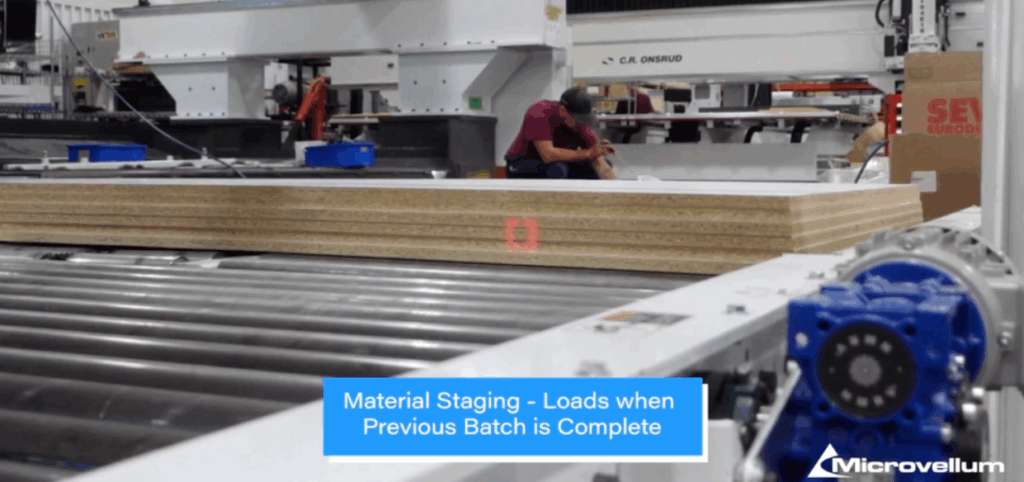
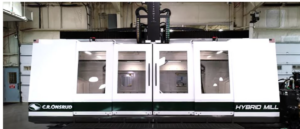
You know the saying goes, time is money. Right? So, if we can save that company time doing multiple processes or one individual thing that really is hindering, kind of, their production, then it’s worth at least taking a look at. So, the machine behind me here has multiple spindles, multiple drill heads, full automation of loading and unloading but also pre-staging. So there’s no time to wait on a forklift driver to bring more material over. So, we’ve kind of looked at all the different ways we can take time out of that process because at the end of the day most companies want to be profitable. And the longer it takes to do something, the less they can put out, and essentially the more we can put out, that takes less time, the more profit we can make. So at that point everybody wins. There [are] a lot of options and this particular model is a moving table. A moving table is a little faster of a solution in terms of acceleration, the deceleration. You’re reducing the cycle time of the actual cut. So, yeah, for this particular company, you know speed was everything. So, we checked off all the boxes, implemented a lot of automation, [and] looked at the one of the fastest, most reliable solutions that C.R. Onsrud manufacturers, and ultimately it was the right fit form and taking their business to the next level.
Garin Trimble:
What are the benefits of an integrated Auto labeling system compared to the more common on-demand labeling system included in most software options?
Thomas Tuck:
If I have to manually apply 10 labels, maybe 90% of the time those labels are in the right place, and I got 10% that they’re not, and I got 10% more problems. So, anything that I can automate allows me to have more productivity at the end of the day and labeling as an opportunity to do that. Not only because it can happen before the sheet even turns into parts. But also it can be done accurately. And very, very reliable.
Garin Trimble:
Yeah, if I could add, there’s also a cool factor to the process, too, of labeling parts for you from the CNC’s, pretty awesome.
Thomas Tuck:
Yeah, it’s a great example of an investment. I mean, it’s not inexpensive to automate labeling. So, there’s an ROI process to anything. So, if you are a manufacturer and you’re manually labeling, look at the rework, look at the parts that go missing. What are we having to redo and what’s causing us to turn gray and pull our hair out? What is the value of that? And also, what time or what amount of time does it take an operator to physically apply those? Add those numbers up. And we’re gonna pretty quickly be able to determine together labeling the way you’re doing it now is the best option or automating is the way to go.
Garin Trimble:
Yeah, much like with all of this, if we can save time and eliminate errors, then great, that equals ROI for the business.
A lot of customers may be watching and they have a three-axis machine. They’re thinking to themselves, am I ready for a five-axis machine? What would you say?
Thomas Tuck:
You know, that’s a great question. But you know what comes before five?
Garin Trimble:
Four.
Thomas Tuck:
Four! And for a lot of people a 4-axis, where I’m rotating a horizontal aggregate or a saw blade or adding an aggregate attachment, can be the right fit for them. 5-axis is, it’s kind of, a different game, if you will. So a lot more to think about in terms of size of machine, how big of a part do I want to do, and Z-height and clearances, and software [is] a huge important aspect in 5-axis more than 3-axis, because my 3-axis software that I’m running cabinetry on it, may not be the right fit to run a 5-axis, right? So, are you open and willing to learn more software? Different software? But also, kind of a different mindset, different way of thinking when you’re programming that? So, you know, it’s an exciting piece of technology, 5-axis and some of the things that we do at trade shows, and we sell a lot of 5-axis machines, and so there’s a lot of times it is a great, great fit for people. But we also do a lot of 4-axis machines, and a lot of times that is a better fit because of, maybe the software aspect, or just really not needing to have that investment, or that purchase that doesn’t equal investment. You know, it’s definitely a kind of a deeper conversation, and something we would love to have that opportunity to figure out together. Hey, is it the right fit? And have that company tell me why they’re even thinking about it. Let’s figure it out together.
Garin Trimble:
So where does a controller fit into all of this? How important is it?
Thomas Tuck:
Very important. It’s the brains of the CNC. So, it does a lot of things behind the scene that a lot of people don’t understand: translating, post-processor and NC files and CAD/CAD code into G-code, M-code, the language that a CNC runs off of. So, if the brain of the machine isn’t reliable, doesn’t offer productivity and performance, you’re kind of not really getting as much out of your investment as possible. So at C.R. Onsrud, we use industrial controls. We are FANUCs® largest OEM in North America, and FANUC is the largest control manufacturer in the world — very well known for that performance and reliability. And just to give you an example, 30 years down the road, you want a part for a FANUC machine? They have a guarantee on that. They measure their downtime in decades: 52 years as the mean time between failures. So, if you’re struggling with that parts and service aspect, and you’re a CNC owner now, or you have no idea what I’m talking about, but you’re curious, it’s definitely something that’s important to consider and why that reliability, why that guarantee, can equal more dollars, more productivity for your business. So, it’s a very important thing, and another one of those things that kind of gets overlooked. Right? When we’re at a tradeshow, we kind of get so excited about what a CNC can do, but not a lot of people are curious or really, really even understand, how does this thing even run? Like where does the information come from? And you know, why is that important? So, you know, those are things that we’d love to educate people a little bit more on and help them understand why it’s important, and how that machine can really be profitable and productive with the right control system.
So, you know in addition to that profitability, and productivity, reliability, ease of use, you put an ad in the paper for a CNC control operator, CNC router operator, FANUC is taught in a lot of schools, so that can really bring people a lot of peace of mind that: Who am I gonna run this thing? And if my operator leaves, how am I going to still manage my business? Well, the ability to find somebody that understands that, and knows that, or has had some experience with that, whether they’re coming from the metal or the Aerospace industry. FANUC being the most common, your likelihood of finding someone is pretty high.
One thing I kind of forgot to mention on that reliability aspect is you have your industrial controls, being the example in the preferred control manufacturer that C.R. Onsrud uses. But you also have the other side of a PC control. Both of them kind of get the job done the same way essentially, but that aspect of reliability and performance is a huge, huge difference for a controller made and designed and engineered to run in difficult environments and kind of put through the paces and there’s a level or a standard that they meet. A PC is not essentially designed to run a CNC router. It can do it. But at the end of the day, the investment is in something that’s kind of made for that type of CNC equipment and yeah, that type of technology.
Garin Trimble:
Just walking through many factories, even at tradeshows, seeing all different types of CNC equipment. Some of them look like they’re sitting on toothpicks. Some of them look like the extreme opposite of that, like the one behind us. How important is machine weight?
Thomas Tuck:
It’s not an irrelevant factor. Let’s put it like that. But the design, engineering, and construction of that machine is probably more important. Definitely more important. You don’t want a dump truck. There’s zero to 60 in an hour, right? You want good fuel efficiency, good speed. Right? So, you’ve got to have the right mix of everything in that puzzle. So, we design and engineer our equipment using full F.E.A.-analysis, thermal-stress relieving, thick heavy steel, but it’s not over-engineered, so it just looks big. It still performs fast, like a Ferrari or you know Cadillac with a super-turbo engine in it, or what have you. That’s kind of where we want to find that good mix of everything, rather than building it on toothpicks or building like a dump truck.
Garin Trimble:
So in software I always deal with this question a lot, but on the CNC side, what options are available to help minimize part movement?
Thomas Tuck:
So, I like to make smoothies, right? And doing that you’ve got to have proper ingredients.If I leave out the strawberries, it just doesn’t taste as good. It’s not a successful smoothie, right? So the ingredients of a good part hold-down — a lot of it is software, a lot of it is proper vacuum flow. So, not just having the size of pump that you may need but flow distribution of vacuum that comes down to the design, engineering of the machine that you have or that you’re considering.
Tooling can be an important aspect and that too. If I’m trying to cut something too fast with a ½-inch diameter cutter, be putting a lot of force on that part; if I went to a ⅜-inch diameter tool, I’m putting less force. So, there [are] a couple variables there. So, essentially those ingredients are kind of the same core things, but the flavors change a little bit based on the material you’re cutting, the type of machine you have, how fast and productive you want to be. So, software, tooling, vacuum flow distribution, holding that part down: those are the main key factors.
Garin Trimble:
Yeah. Certainly.
How important is Tooling in all of this?
Thomas Tuck:
There’s the price of machine: what does it cost me to purchase this? But then you have the cost of machine, right? What is my operation cost? And tooling, you’re using them every day, right? So, that can be a big factor in that profitability and use a lot, utilizing CNC technology. So, there’s a lot of math that kind of goes into tooling that some people don’t understand to maximize your chip load, which ultimately helps you prolong or maximize the life of that tool. So, I recommend to a lot of people no matter what industry they’re in, what type of CNC they have, whether it’s an Onsrud or different brand, you know to lean on your local tooling rep, or even call C.R. Onsrud — we have an in-house tooling department that has a lot of expertise, a lot of knowledge. Has seen the good, the bad, and the ugly, and can make great recommendations on how to help you improve the life of the tool, improve the quality and the finish of that cut, improved part hold-down, or even if it’s something custom, custom profile or an aspect of tooling that will help you decrease the cut time and improve that production capability.
Garin Trimble:
Now most shops would love to add a CNC like we see behind us or any CNC. What are some of the hurdles though that they would face in implementing that into their business?
Thomas Tuck:
I’ve probably seen it all. But I think one important thing is the feedback that we get and, kind of, the excuses that companies give themselves not to do it. So, I mean you have your very basic and common things like, we don’t have enough space, we can’t get financing, we’re just not at that level yet, I don’t have a door big enough to actually fit it in the room — common things like that. And in a lot of those are true stories and aspects that are limitations. Some of those things we talked about earlier: facility requirements, power. But one thing that I hear sometimes from some people at companies where there’s a team of people, let’s say it’s six people that are all on this committee of finding and selecting the right CNC for their business, there’s always one person in there that kind of throws a wrench in it. And I’ve heard everything from “Well, the production manager doesn’t want it. He wants to keep all his employees.” Well, when you invest in technology, you’re more profitable, you’re more productive. You can actually probably look at it the opposite. You’re gonna need to hire more employees.
Garin Trimble:
Absolutely.
Thomas Tuck:
Right? It’s not replacing, sometimes. Retraining, right? So, that’s kind of a common misconception that automation is replacing people. And that does happen. But there’s also a variable that this is gonna help us grow, we need to retain those people, retrain, and that we’re probably going to need to hire some new people because we’re gonna be so busy, right? Getting the buy-in of — let’s pretend that your company has a CNC now and this guy, he loves this router, this CNC, and you’re considering investing in something that’s more profitable. I’ve had operators kind of really push back on replacing a CNC with more technology because they fear it’s kind of, are they looking at his job security? If they get something that’s more productive, what do they need me for? It’s a kind of going back to the previous example. I mean, we still need operators. We still need assemblers. We still need programmers. So, trying to get the buy-in of the people on the floor is very important, because ultimately in the, let’s say the upstairs or in the office, the people that see the the numbers, if you don’t get the buy-in from the people on the floor and you put it in place, it’s probably not going to be a successful as if you incorporate their feedback. Definitely look at it as a team aspect to overcome those hurdles.
Financing can be another common thing. We like to help people with that, if we need to, enhance financing. Or even simple things like helping the ROI and the justification, and we can do cycle times, we can do demos. You can tell us, here’s the goal that we need to have to justify this. How can we get there? And what does that package look like? And if it fits great, everybody’s looking like Superstars, and we all win, and we make new friends and new partners. And sometimes it doesn’t and that’s okay. Let’s revisit in the future. So, you know that partnership of what we try to do at C.R. Onsrud is very important. Because we want to be a part of the team, helping the justification, help you overcome those goals, implement the solution, get the buy-in of the team, and kind of educate you on that process along the way.
Garin Trimble:
All right, Thomas, you’ve sold me. I am buying a CNC. How much does it cost?
Thomas Tuck:
First off, hopefully, it just wasn’t a sale. Hopefully, it was an investment because essentially that’s really what it is. And our goal is to help you maximize that return on investment with the right solution. So, in general CNC routers, machining centers, can range from $5,000 to $5 million. The justification, as part of that process, but essentially every manufacturer wants the same thing, I want to make more money. In some ways, the price of the machine is one thing. The cost of the machine is another thing. But what is that return on that investment? I could work with somebody on a less expensive machine that’s going to give them a really quick payback and return on that investment. But eventually they’re gonna have to buy a second one because they’ve maximized the capacity. Whereas if that machine was more expensive to begin with, and they grew into it, long term they’re gonna have a better return on that investment, right? So there’s a lot of variations, a lot of variables, to really answer your question appropriately. But what it costs is really based on what is the profitability that you’re going to receive out of it?
Garin Trimble:
Absolutely. And really with that too, shop owners tell me all the time, two things they wish they would have done sooner: Buy Microvellum and Buy their CNC.
Thomas Tuck:
There you go.
Garin Trimble:
You usually say those are the best two things they’ve ever done as far as business decisions.
Thomas Tuck:
Yeah, like we were talking about earlier. There’s no right time. If you have a problem, there’s a way to solve it. And sometimes you may think, “Well, I don’t have enough space” or “It’s not the right time” or “I don’t want to spend the time to run more compressed air.” Well, if you buy the CNC, when you buy the software, you’re kind of forcing yourself in a way to implement those pieces to the puzzle to get that return on investment. So, you know not to say you want to put the cart before the horse all the time, but if you keep waiting till the right time, or you don’t really look at it as that return on investment, you may never get there and eventually you may be behind.
Garin Trimble:
Yeah. Usually the only regret is that they didn’t make that decision earlier.
Thomas Tuck:
Yeah. Absolutely. Absolutely and speaking of investment, I mean, I’ll go back to something we talked about earlier. I mean, software is such a huge aspect of that investment. I mean me, personally, I would much rather spend less time clicking and drawing and things like that, and not have to have a full-time CAD/CAM operator or CAT engineer and implement some automation on the software side, so that I can get things out to the shop quicker improve the stream of information, improve the process and the flow. A CNC is only as good as its software in a lot of cases. So, that’s a big important piece of that overall investment as well.
Garin Trimble:
Thomas, thank you so much for having us out here, answering all these questions for us. I’m positive that everyone watching this is very appreciative of all your answers and your time.
Thomas Tuck:
You’re welcome. Thank you guys for coming out. I appreciate the opportunity to talk a little about some fun stuff today and challenges and goals and things of that nature. I got a surprise for you.
Thomas Tuck:
You still have that USB stick with those programs on it?
Garin Trimble:
Absolutely.
Thomas Tuck:
I’m gonna teach you how to run this thing. Let’s go have some fun.
Garin Trimble:
Let’s do it.