

TL;DR — Quick Answer
By investing in new CNC technologies, manufacturers in the Aerospace and Defense sectors can position themselves to capitalize on significant increases in federal defense funding and industry demand.
Read on for the full details and specific recommendations.
Accelerating demand and increased federal funding in the Aerospace and Defense (A&D) sectors offer significant opportunities for manufacturers. By integrating new CNC technologies into your workflow, you gain a competitive advantage.
A&D demands are high and constantly evolving. Every component must be precision-machined, structurally stable, and function without failure. The slightest deviation can compromise performance and risk lives.
The most competitive companies use CNC solutions to scale production effectively while maintaining strict quality standards in this highly regulated environment. Key benefits with the right CNC machine:
- Move innovative designs from R&D to production quickly.
- Produce accurate complex, intricate geometries.
- Deliver high-quality products on time.
- Process challenging materials, consistently and reliably.
- Handle both short-run orders and large-scale production.
- Accommodate oversized parts.
5-Axis Advantage
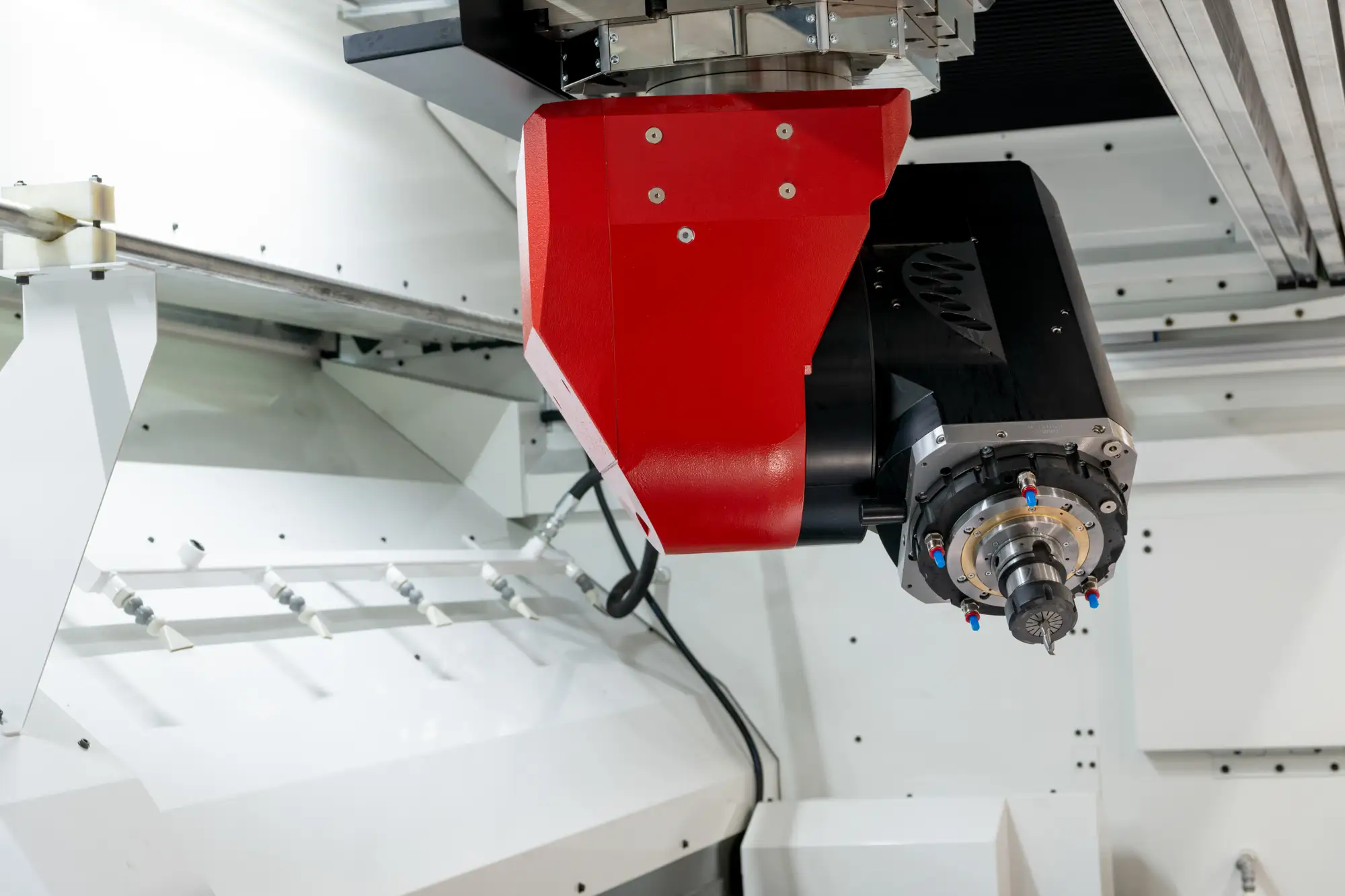
A&D components increasingly cannot be produced competitively without a 5-axis CNC machine. It’s not about what a 3-axis machine can’t do, but what the 5-axis machine does better:
Completes complex parts in a single setup. A 5-axis machine produces fully finished components in a single setup. Machining complex geometries on a 3-axis machine requires multiple setups and frequent refixturing, introducing potential errors with each adjustment.
Achieves tighter tolerances on complex geometries. On a 5-axis machine, the tool maintains a constant, optimal cutting angle relative to the material. This supports more rigid tooling that reduces vibrations to consistently maintain dimensional accuracy compared to a 3-axis machine.
Eliminates the need for secondary operations. The optimized tool orientation and continuous toolpaths on a 5-axis machine minimizes vibration and improves chip evacuation to produce superior finishes. 3-axis machines require manual repositioning and refixturing, which introduces cumulative alignment errors, making post-process work necessary.
Reduces cycle times. By handling all intricate contours and compound angles in a single setup, the 5-axis machine is more efficient. You can quickly move your innovative designs (prototypes) seamlessly from R&D to production and deliver more parts, faster.
Other Machine Considerations

The machine directly affects the accuracy of your part. Here are other factors to consider:
Rigidity. A machine with a heavy, vibration-dampening construction produces better quality cuts than a lighter machine running the same program. Consider not just the spindle specs, but also the machine's bed mass and structural design.
Volumetric accuracy. To achieve the strict A&D tolerances, use glass scale linear feedback and volumetric compensation software. This ensures high precision is maintained throughout the machine’s entire 3D volume rather than isolated to a single reference position.
Working envelope. Composite aerospace structures vary widely in size — from small brackets to full wing skins. Evaluate work envelopes against the actual material and part size, including fixturing height and machining at a 90° on a 5-axis machine.
Support and Service. Understand what, or if, service and support is provided, by whom (the OEM? Dealer? Third-party mechanic?) and where they are located. Consider lead times on replacement parts, if the company offers 24/7 phone support, and what that costs.
Working with Advanced Materials
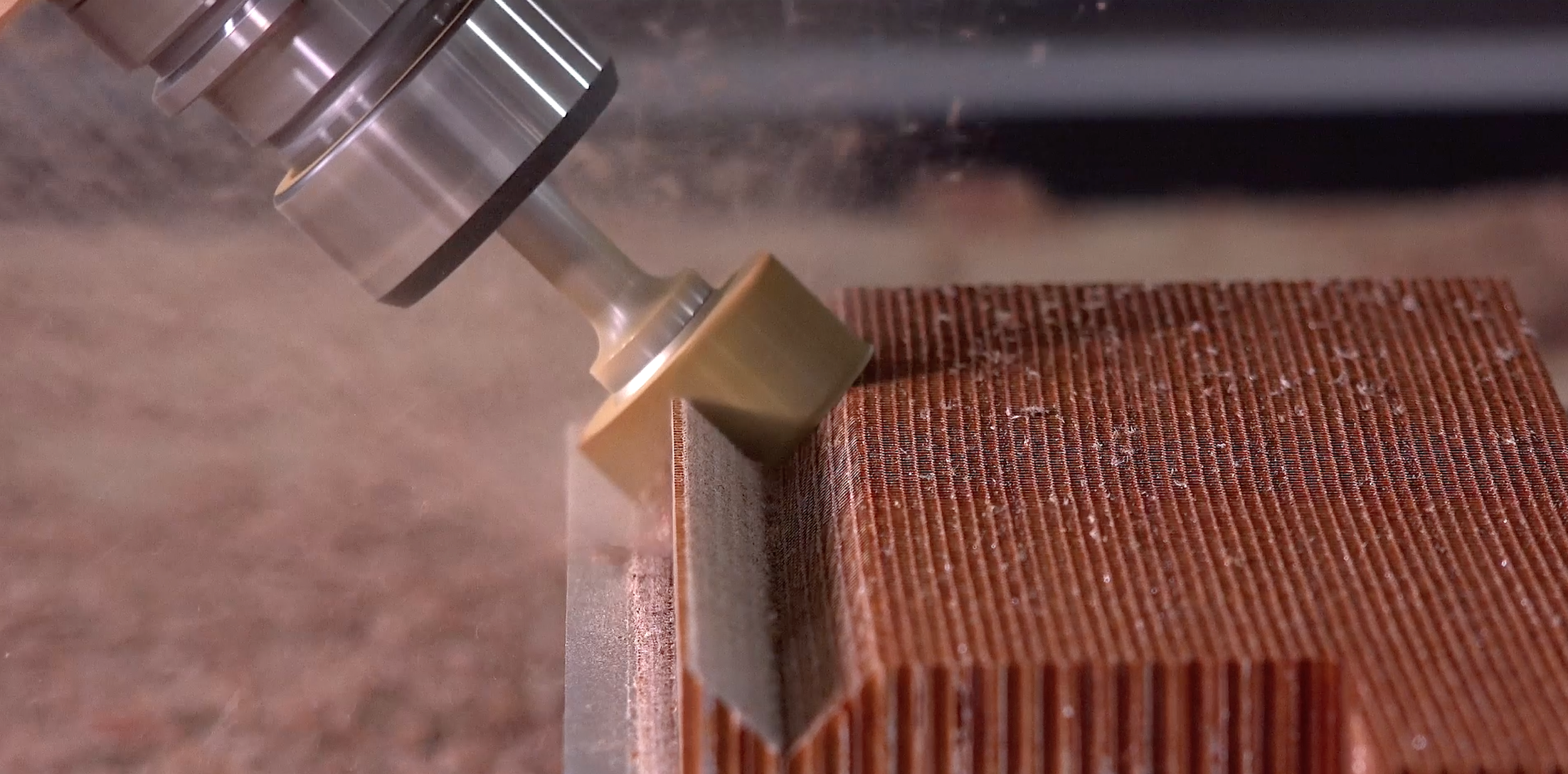
There are a wide range of materials used in the A&D industry, such as aluminum, plastic, foam, honeycomb core, titanium, and alloys.
Recently, the use of composite material has been on the rise. Carbon fiber is growing at a projected 8.6% CAGR in the A&D market and thermoplastic composites are on a similar trajectory. Composites offer maximum strength, design flexibility, and corrosion and temperature resistance in a lightweight structure. Products made from these materials perform better and at a lower operational cost, in part due to fuel efficiency.
However, the demand for composite parts is higher than legacy production methods can supply them. To compete in this market, you need a 5-axis machine and modern specialized manufacturing techniques. Here are some factors to consider:
Rapid tool wear. Carbon fibers accelerate edge wear faster than most metals. To avoid the need for frequent tool changes, you need either diamond-coated tooling or specialized carbide grades. You can also extend tool life by investing in a rigid, vibration-dampening CNC machine when working with abrasive materials.
Delamination. Composites are direction-dependent (anisotropic). With 5-axis capability, the tool can approach the material at the optimal angle. Combined with high rpm and low torque spindles, you can reduce the cutting forces that cause fiber pullout, fraying, or delamination.
Dust management. Because carbon fiber (CFRP) dust is both electrically conductive and hazardous to breathe, machines need to be enclosed or semi-enclosed with an integrated HEPA-filtered dust collection, and the electrical system shielded against dust infiltration. This is a consideration that metal shops moving into composite work frequently underestimate.
Inspection requirements. A&D inspections for composites are generally higher and more complex than those for other materials (e.g., metals), requiring traceability, dimensional inspection, and advanced NDT (non-destructive testing). The machine's accuracy and repeatability directly affects the accuracy of the part and first article inspection (FAI) results.
Valuable Advanced Technologies

Adding strength without adding weight, there are advanced CNC technologies that are especially valuable to the A&D industry where legacy machines cannot compete:
Flow Drilling. Creates strongly threaded connections, increasing the thickness of the wall — as much as 3x! — as it drills, providing additional strength even in compact sheet metal and pipe-shaped profiles.
Friction Stir Welding. With the use of minimal heat and high pressure, softened particles are blended together at the seam, fusing different parts into one molecularly cohesive piece. It produces defect-free bonds without the added weight caused by bolts or rivets, and without using flux, fillers, or shielding agents. Not only does it deliver higher joint strength than many other methods, the fused area in most cases is stronger than the individual base materials. See the use of Friction Stir Welding to produce EV Battery Trays in this YouTube video.
Making the Capital Case
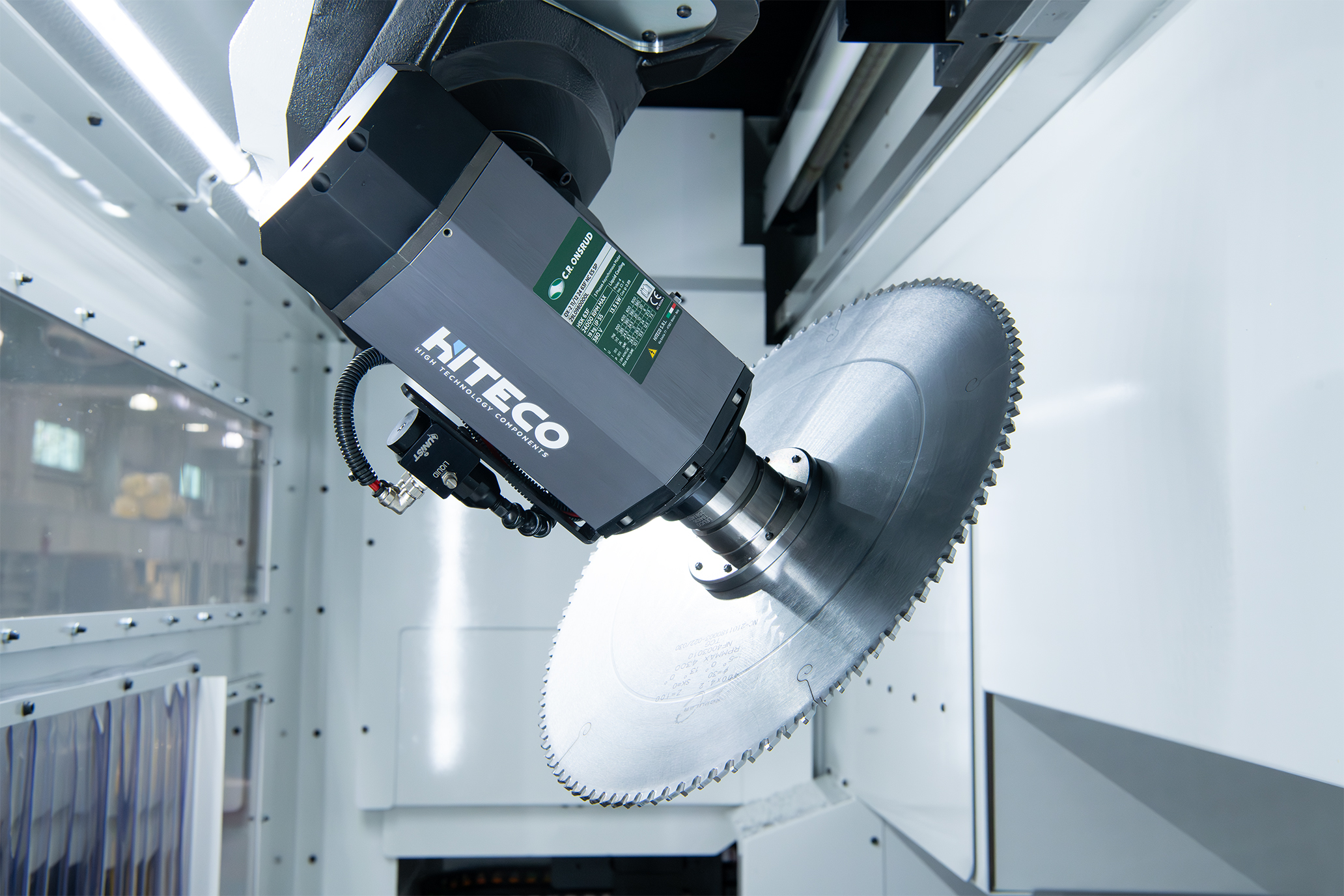
The FY2026 National Defense Authorization Act authorizes $900.6 billion for national defense, which includes funding specifically directed at F-35 production and naval shipbuilding expansion. With accelerating demand for innovative A&D parts and increased federal funding, Tier 2 and Tier 3 aerospace and defense subcontractors are in position to gain a competitive advantage.
Purchasing the right capital equipment — a 5-axis machining center that accurately processes composite materials — is a strategic first step. You can capitalize on the sustained defense budgets that ensure long-term composite part orders and the commercial aerospace production that requires qualified suppliers.
From there develop a documented AS9100D-aligned process. Keep in mind, major defense contractors are asking Tier 2 and Tier 3 suppliers for evidence of machine capability before awarding composite machining work.
For additional information and support, contact C.R. Onsrud to discuss 5-axis composite machining configurations — including working envelope, accuracy options, and dust management — for your specific application and part mix.
5-Axis Machines for Aerospace and Defense
C.R. Onsrud has your machine, whether you’re making parts for navigation systems, military vehicles, surveillance equipment, unmanned vehicle technologies, weaponry, communication devices, mechanical assemblies, aircrafts, mobile hospitals, or military barracks.
Their CNC machines are manufactured in the U.S.A. Sourcing domestically makes it significantly easier to satisfy strict regulations (e.g., DFARS, ITAR). Should you need technical assistance, the technicians are based in the United States as well.

Q-Series is a cost-effective, fully enclosed 5-axis CNC machine ideal for shops entering composite work or running moderate-volume composite components.

5-Axis G-Series and 5-Axis E-Series provide the heavy-duty frame rigidity and configurable working envelopes for high composite production and larger structural parts.

5-Axis HM-Series provides the high torque necessary for nonferrous, ferrous, and advanced composite materials without sacrificing the high rpm needed for high-speed machining of aluminum, fiber-reinforced plastic, PVC, carbon fiber, a-cell, phenolic, and other innovative materials.

5-Axis CH-Series handles the extreme weights of large nonferrous, light ferrous, and advanced composites for demanding applications.
For shops machining very large composite assemblies — full panels, marine superstructures, or aerospace jigs and tooling boards — the HR-Series and LR-Series offer working envelopes as wide as 21 feet and 100 feet long with Z-strokes up to 10 feet.
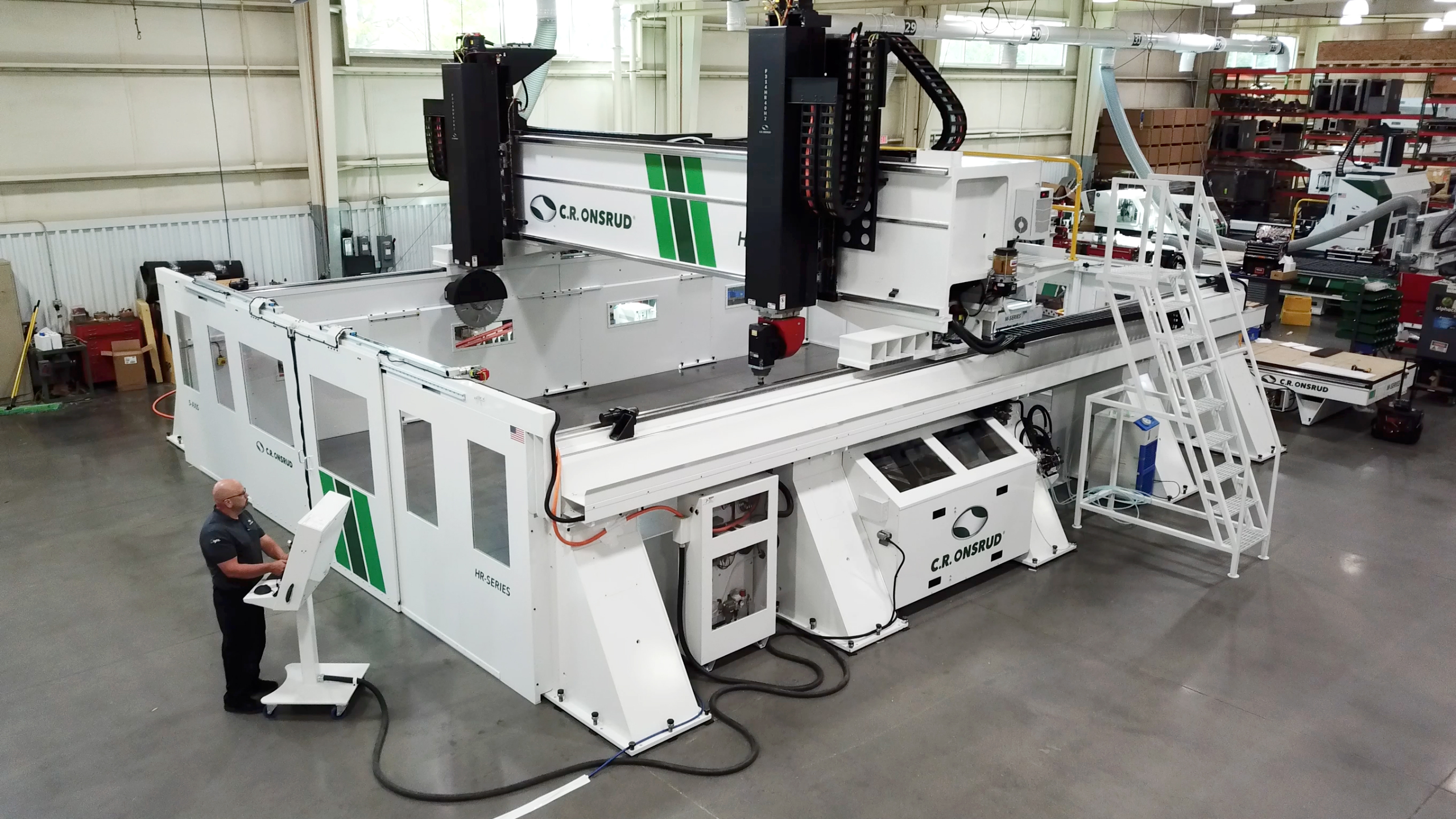
Each machine is operated using a full FANUC Controls System for optimal performance and reliability. Controllers come with lifetime product support (so the controller will not become obsolete). FANUC works seamlessly with all major CAD/CAM software.
Frequently Asked Questions
Why do I need a 5-axis CNC machine?
With a 5-axis machine, in a single setup, you can create 3D shapes that require tool access from any angle, including undercuts that 3-axis machines cannot reach.
As A&D parts have become increasingly more complex, thousands of components must align precisely. Any deviation compromises performance and risks lives. 5-axis machines produce more precise results than 3-axis machines and are engineered to process materials that are ideal for the A&D industry, including composites with their desirable strength-to-weight ratio (e.g., carbon fiber and thermoplastic).
Why is now a good time to buy?
Accelerating demand for parts from qualified suppliers (Tier 2 and Tier 3) and sustained federal funding in the Aerospace and Defense (A&D) sectors make it an ideal time for manufacturers to gain a competitive advantage with new CNC technology.
How much does a 5-axis CNC router cost?
5-axis CNC routers are a significant capital investment. Pricing depends on work envelope, spindle power, controller, and automation features. If you’re currently using a traditional milling center, 5-axis CNC routers are substantially less expensive and perform much faster.
Contact Contact C.R. Onsrud for pricing details based on your specific application, goals, and machinery needs.