
What to Evaluate Before You Buy
Key capabilities that are vital to most cabinet shops:
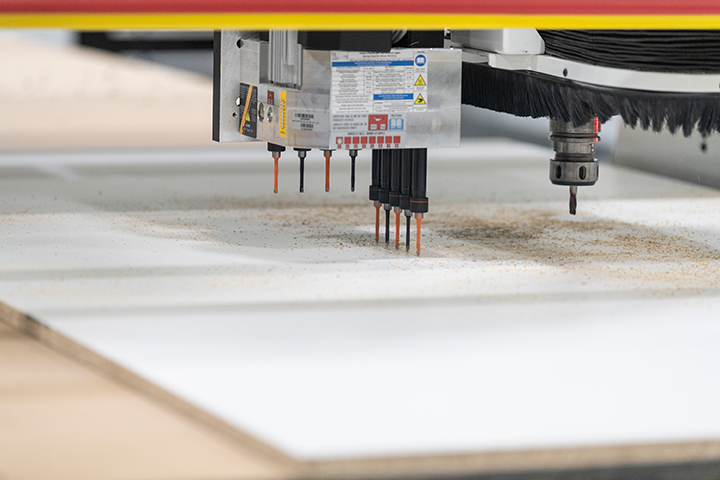
Drill (boring) block configuration: Most cabinet production requires line-bore holes for shelf pins and hinge plates. An integrated drill block handles this in the same program as the profile cuts, eliminating a separate boring operation. Verify the block pitch matches your system — 32mm European is standard for most shops, and 9-spindle or 13-spindle configurations cover the most common cabinet applications.
Vacuum zone layout: Nested-based production requires independent vacuum zones that can be selectively activated based on material coverage. When a zone is not covered by a workpiece, it should be isolatable to prevent vacuum loss from bleeding across the table. Evaluate how the machine's zone layout maps to your standard sheet sizes.
Nesting software integration: The machine is only as productive as the programs feeding it. Ensure the CNC machine seamlessly integrates with the CAD/CAM software, rather than relying on a standalone nesting system. Inefficiencies in the programming workflow is where shops lose cycle time.
Z-height clearance: Cabinet door profiling and raised panel work require adequate Z-stroke for the tooling and workpiece stack. See if the standard configuration covers the height you need or what the cost is for an upgrade.
Service and support: Downtime of a CNC router directly results in lost production and stalled revenue. Evaluate factory service response times, parts availability, and regional support coverage. Shops that buy based on lowest upfront price often spend weeks waiting for service support. These delays result in lost productivity that is far more costly than the initial savings.
Machine Types Relevant to Cabinet Production
Moving gantry nested-based CNC routers are the standard for cabinet shop panel processing. The table is fixed; the gantry moves over it. These machines are designed specifically for sheet goods: configurable vacuum zones, nesting software integration, and optional boring blocks.
The A-Series performs all the essential functions needed for cabinetry in a small footprint and at an attractive price. It is available with single-phase or three-phase power.
The M-Series is ideal for cabinet shops when floor space or budget is limited but production needs and expectations are not.
The T-Series is a production panel processor. Built for throughput, it easily integrates with automation options (e.g., conveyor loading, infeed and off-load tables, and material-handling systems).
The G-Series offers a wide range of table sizes (from 5′×12′ to 12′ wide by 100′+ long). It is the single platform for shops that process different materials (mixing standard sheet goods with heavier stock or panel composites).
Frequently Asked Questions
What CNC router do I need for cabinet making?
A nested-based CNC router with vacuum hold-down and drill (boring) block integration is the standard for cabinet production. Look for independent vacuum zones, nesting software compatibility, and adequate Z-height for cabinet door profiling.
Can a small cabinet shop justify a CNC router?
Yes. Modern nesting software handles short-run custom orders efficiently. A shop running even 3–8 cabinet boxes per configuration benefits from the consistency and labor redistribution that CNC automation provides. For more information, see When Does a CNC Machine Make Sense for Cabinetmakers?
A CNC router seems expensive. Is it worth the money?
Investing in a solid CNC router with a track record for durability and reliability is worth it. Look at the design, engineering, and construction of the machine because rigidity matters — giving you precise cuts when working with the materials in the cabinet industry. C.R. Onsrud, for example, uses full F.E.A.-analysis, thermal-stress relief, thick heavy steel for every router in their line. But the machines aren’t overengineered just to make them look big. They’re designed for fast performance and long-term reliability.
Watch out for cheaply made machines. Imported ones especially may appear less expensive initially, but wind up often carrying tariffs of 9% to 14% and are too flimsy to give you high-quality results. Plus, you’ll need to replace them in a few years.