
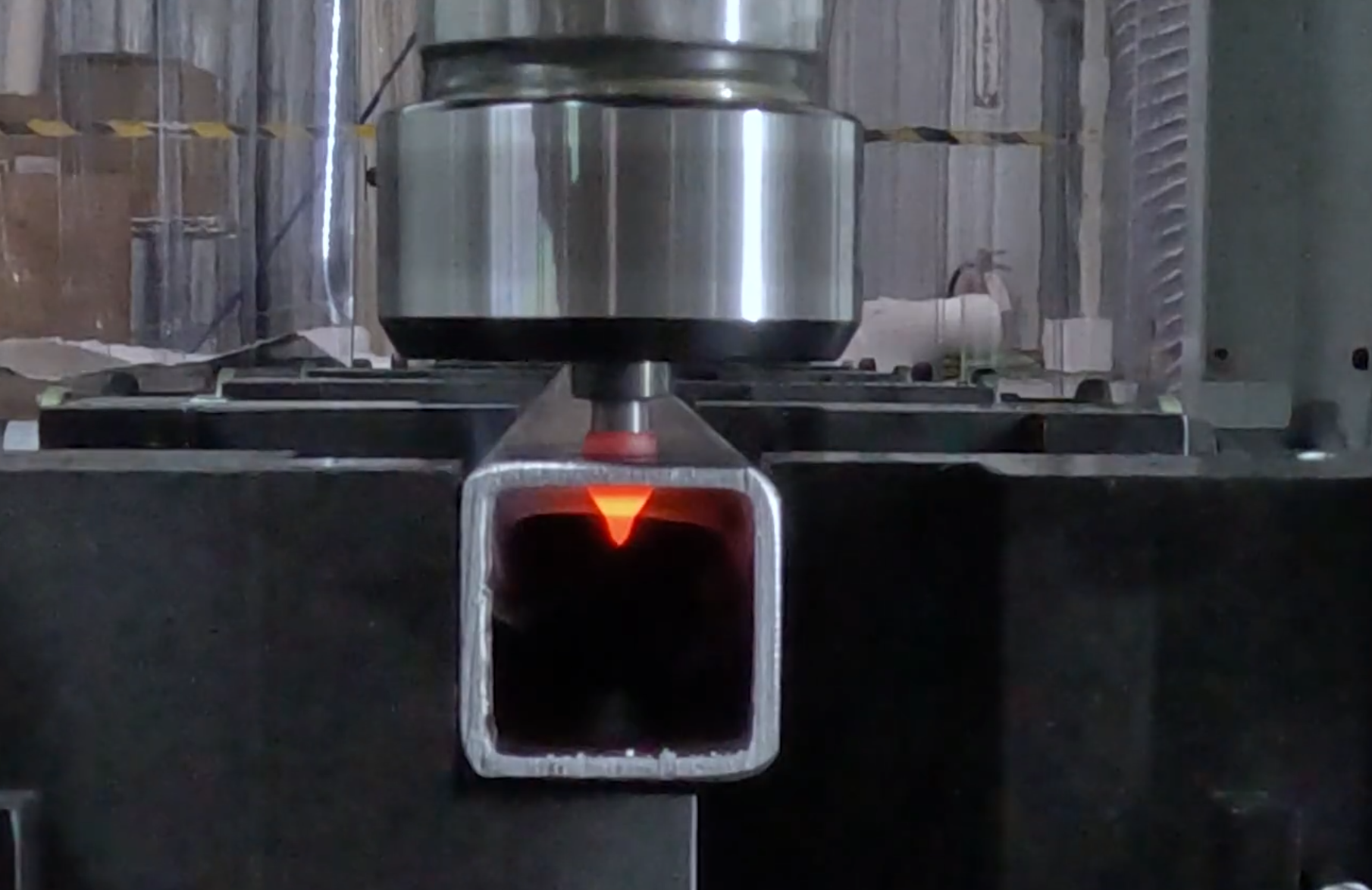
What is Flow Drilling?
Also known as friction drilling, flow forming, or thermal drilling, this unique process uses the heat from friction to soften and displace metal to create strongly threaded connections. It requires no cutting or welding and does not produce swarf unlike the traditional drill press. It is a cost-effective alternative to typical mechanical fastening methods and works on a wide variety of metals (e.g., aluminum, steel copper, brass) and even in locations that are hard to access.
Here’s the scientifically fascinating part about FSW:
There is no need for weld nuts, rivet nuts, or other extra inserts to build in thickness. Flow drilling creates strongly threaded connections, increasing the wall — as much as 3 times! — as it drills!
What is Friction Stir Welding? (FSW)

With the use of minimal head (caused by friction) and high pressure, the friction stir welding technique blends (stirs) softened particles together at the same to fuse (weld) different parts into one molecularly cohesive piece. This solid-state welding process is often used for materials that are difficult to weld (e.g., aluminum alloys, copper, magnesium, titanium, steel, stainless steel, nickel, lead, zinc, and thermoplastics).
This unique method provides defect-free bonds without adding the weight caused by bolts or rivets, and without the use of flux, fillers, or shielding agents.
Here’s the scientifically fascinating part about FSW:
FSW delivers higher joint strength than many other methods, and due to refinement of the material’s grain structure during the FSW process, the fused area in most cases is stronger than the individual base materials.
Additional Resources
Friction Stir Welding (+) Machining on One Platform
Friction Stir Welding & Machining on an Onsrud CNC Milling Machine to Produce EV Battery