
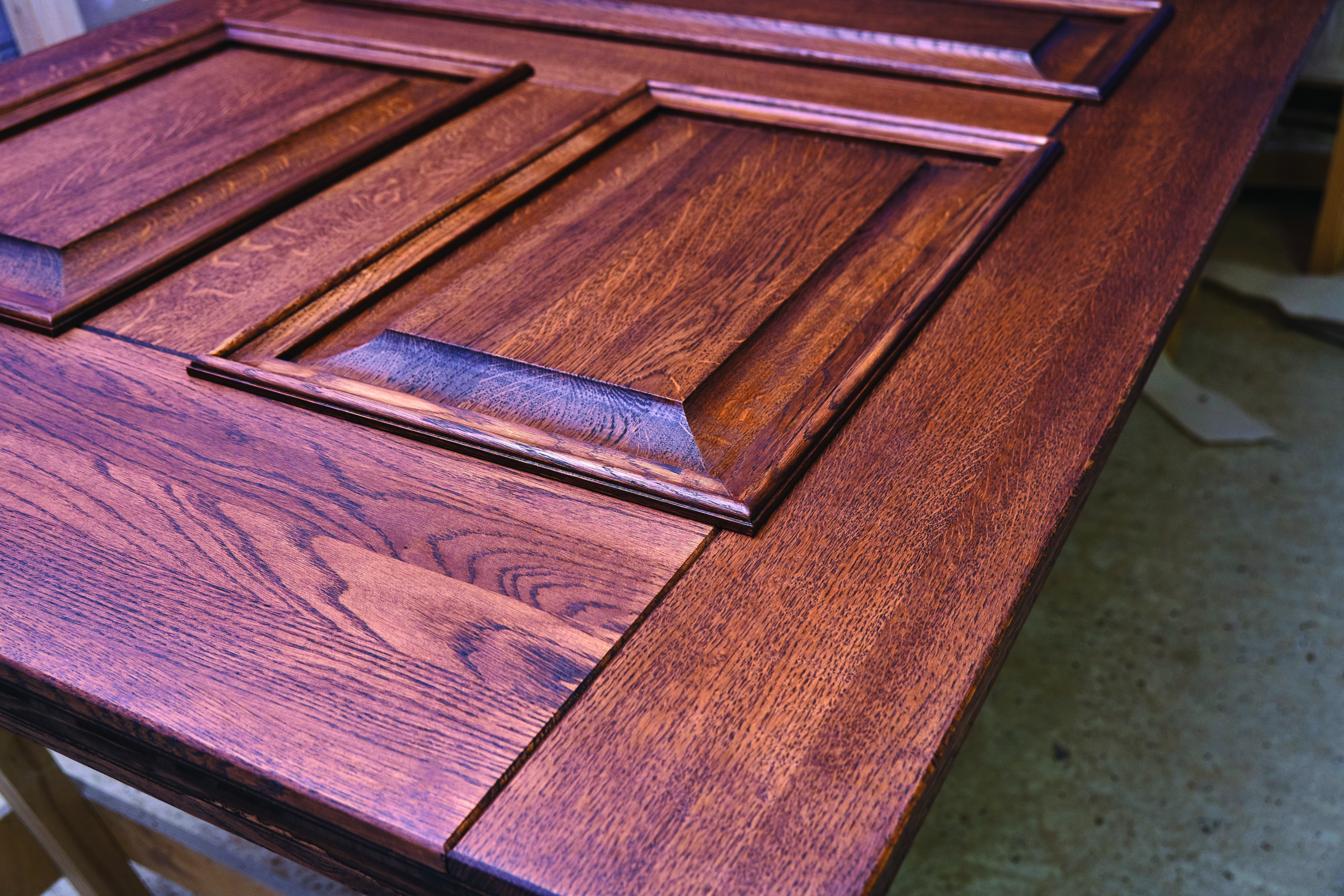
High-Quality Doors: Install-Ready Finishes Straight Off the CNC Router
If you are currently manufacturing doors using manual processes, you are likely missing out on profitable opportunities.
A CNC router streamlines your production, giving you adaptability to scale your business alongside new trends in door manufacturing and the growing demand for custom doors.
Increased volume and time savings are only part of the value you gain from the investment. Transitioning from a manual shop floor to an CNC automated one is about more than just the cost of a machine; it is about the value of that investment — solving the inherent inefficiencies in manual operations, eliminating measuring and other costly errors, ridding the need for hand sanding, and maximizing material yield. You can shift your team’s focus from repetitive tasks to high-value craftsmanship and jobs that grow your business.
The Inherent Inefficiencies of Standard Operating Procedures
In the door manufacturing industry, the traditional, manual production shop (using table saws, shapers, planers, plunge routers, clamps, and sanders) has costly, inherent inefficiencies. These inefficiencies are often characterized as standard operating procedures, and therefore, not recognized, however, they have a significant negative impact on your profitability.
Some of the traditional manufacturing steps may include:
- Placement on a planer to achieve an exact, uniform thickness.
- Transfer to a panel saw or equivalent for rough cutting and sizing.
- Transfer to a shaper or moulder for profile routing.
- Transfer to a separate panel-raising shaping station if building a 5-piece raised panel door.
- Transfer to the drill press or boring machines for hinges, locksets, and dowel joints.
- Transfer to the sander for removal of dwell marks (aka chatter marks or tool marks).
Each transfer increases the risk of damage, misalignment, or downtime as operators wait on parts from the prior station.
The Built-In Efficiencies of Nested-Based CNC Routing
By processing multiple door components from a single sheet of material, you consolidate the steps required for manual operations. With nesting, the patterns are tightly arranged, so you can produce more parts in a shorter time frame.

After the material is loaded, this is the CNC process, in a single setup:
- Vacuum Hold-Down: Holds material securely in place, no other clamps or complex fixturing is needed.
- Dust Management: Automatically captures fine dust and debris.
- Precision Machining: A computer program instructs the spindle to perform all cuts, drill holes, and profiles.
- Automated Tool Changes: The spindle quickly accesses all the tools needed to process the entire door.
- Integrated Saw Blade: Performs precise crosscutting, dadoing, and irregular grooving.
- 5-Sided Processing: Aggregates make specialized side machining possible on a 3-axis machine, such as cutting hinge mortises, lock bevels, and pockets. This capability comes standard with a 5-axis machine.
- Drill Holes: Precise hardware alignment for all the holes for locks, deadbolts, and hinges.
- Assembly-Ready Output: Without sacrificing fast cycle times, parts come off the machine assembly-ready with superior edge quality, eliminating the need for hand sanding.
Estimated Machining and Milling Time (Per Door)
| Full Solid Door | 5-Piece Rail-and-Stile Door | Custom Cabinet Doors (12 count) | |
|---|---|---|---|
| Manual Process | 1–3 hours | 15–20 minutes | 8–15 hours |
| Average CNC Router Cycle Time | 4–15 minutes | 3–8 minutes | 30–60 minutes |
| C.R. Onsrud CNC Router Cycle Time | 1.5–5 minutes | 1–3 minutes | 6–12 minutes |
| Typical CNC routers for door production operate at an average cutting speed of 150 to 600ipm. Most C.R. Onsrud’s routers have 1200ipm–1400ipm cutting speeds and travel speeds of 2500ipm–3500ipm. | |||
Additional time-saving options include:
- Automated Part Labeling: An optional system applies barcodes, QR-codes, or part information to track multiple door components.
- Integrated Load and Offload Systems: Supports safe and automatic loading of materials and clearing the table for the next sheet, so the router is constantly being fed.

Reduce Mistakes
Consider how often a single piece of material is handled and remeasured across several disconnected operations. Each transfer adds cycle time and increases the likelihood of error.
With the addition of a CNC router, not only have you saved substantial time, you’ve also significantly reduced the risk of introducing manual measuring, alignment, and other manufacturing errors.
Material Savings
With the right machine and nested-based operations, your material waste (scrap) is significantly reduced.
With a nested-based CNC router, your parts are arranged in a tight pattern to fit as many parts on the material as possible. The material yield for manual processes is approximately 75% with 25% scrap. The CNC machine yields at least 90% with approximately 10% as scrap. For example:
Estimated Material Savings with a CNC Router
| Material Cost per Month | Material Yield (Manual) | Material Loss (Manual) | Material Yield* (CNC) | Material Loss* (CNC) | Savings per Month (CNC) | Yearly Savings (CNC) |
|---|---|---|---|---|---|---|
| $50,000 | $37,500 | $12,500 | $45,000 | $5000 | $7500 | $90,000 |
|
* These numbers are conservative. Most C.R. Onsrud customers find their material is closer to 92% with approximately 8% as scrap. |
||||||
Labor Shift
You might be thinking buying a CNC machine and reducing labor would save you money. It possibly could, but the CNC machine is only freeing staff from the repetitive panel processing work. You still need people for critical work: design, quality assurance, craftsmanship, edgebanding, assembly, finishing, and delivery or installation. With a CNC router, your shop can run more efficiently with your current team because now parts are continuously fed into the pipeline. They help prevent bottlenecks in other areas once your panel processing has improved.

Routers Relevant to Door Manufacturing
The T-Series is an industrial panel processor with automation options (e.g., conveyor loading, off-load tables, and material-handling systems) for continuous processing.
The M-Series is a compact and economical industrial panel processor, ideal when floor space or budget is limited but door production needs and your expectations are not.
C-Series and E-Series with twin-tables allow one table to be loaded and unloaded while the other is processing material, eliminating idle time between cycles. For shops running the machine continuously through a shift, this pendulum process increases daily output without adding machine time or operators.
Contact C.R. Onsrud to learn more about these machines and to discuss your specific application.
Tooling Considerations
It takes more than the right CNC machine to produce precision cuts and install-ready finishes; you also need the proper tooling. You also need the proper tooling. For door manufacturing, consider sets designed especially for door manufacturers: These kits include the cutting tools needed for door manufacturing as well as the wrench to quickly and easily swap inserts. There’s no need to replace the entire tool when it dulls, just swap out the carbide blades.
Combined with the right CNC router, such as our C-Series, you can create the look of raised panel wood doors and eliminate the need for hand sanding.
The Onsrud Tooling team is available to learn about your specific application, to discuss dialing in your feeds and speeds, and to answer questions you have.
Frequently Asked Questions
Do time savings and increased volume justify the cost of a CNC router?
The cost is not only justified by the time savings and increased volume but also from improved efficiencies, elimination of measuring and other manufacturing errors, maximizing material yield — which can be a huge cost savings. Depending on the machine, you are likely to see a ROI within the first year.
Can a small custom door manufacturer justify a CNC router?
Yes. Modern nesting software handles short-run custom orders efficiently. A shop can benefit from the accuracy, consistency, and labor redistribution that CNC automation provides.
What CNC router do I need for door production?
For 5-piece rail-and-stile doors, a nested-based 3-axis CNC router with vacuum hold-down is the standard for door production. If you primarily produce solid wood doors, you don’t need the nesting capability. For high volumes, an aggregate on a 3-axis machine or machine with 5-axis capability makes horizontal milling possible for hinge mortises, lock bevels, and pockets.
Additional Resources
- How doors are made (videos)
- Window and door applications (webpage)
- Cabinet door manufacturer (customer)